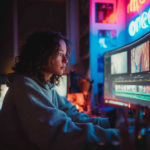

I don’t go to set. Like, ever. I’m an editor. My natural habitat is a dark room with good headphones and zero human interaction. But recently, I stepped way out of my comfort zone and edited a music video while actually being on location at Cinepacks Studios. And honestly? It changed how I think about editing entirely.
If you’re like me and prefer the safety of your editing cave, I get it. But hear me out on why breaking that pattern might be the best thing you do for your career this year.
The Thing Nobody Tells You About Being On Set
Walking onto a film set when you’re used to working alone is genuinely intimidating. There are people everywhere. Equipment you don’t understand. A hierarchy you’re not sure how to navigate. I wore all black because I figured if I didn’t know what I was doing, at least I wouldn’t stand out. (Pro tip: that’s actually proper set etiquette anyway, so anxiety win?)
But here’s what hit me almost immediately: every single shot I would’ve casually scrubbed through in my timeline had an entire story behind it. That simple push-in? It took a motion control rig from Cinema Junkies, three crew members, and twenty minutes of programming. That perfectly lit close-up? Shane Hurlbut. Yes, that Shane Hurlbut, ASC spent real time crafting the look.
When you see the effort that goes into capturing each frame, you edit differently. You don’t just slap clips together. You honor the work. You find the moment within the moment because you know how much it cost to get it.
I’m not saying you need to attend every shoot for every project. But if you get the chance, even once, to see how your footage is actually made? Take it. It’ll rewire your brain in the best way.
Preparation Is Where Great Edits Actually Start
Day one wasn’t even a shooting day. It was prep. And I almost didn’t go because, you know, no footage yet, what’s the point? Turns out, that’s exactly when I needed to be there.
I watched the director, Lukas Colombo (who also happens to be incredible at what he does), walk the actors through scenes using an animatic he’d built in DaVinci Resolve. He’d used Artlist AI to generate the storyboards, which was the first time I’d seen AI used in pre-production in a way that actually made sense. It wasn’t replacing creativity; it was accelerating communication.
Seeing that animatic before I touched a single clip meant I understood the intended pacing, the emotional beats, the transitions Lukas wanted. When I finally sat down to edit, I wasn’t guessing. I was executing a vision I’d already absorbed.
Think about how different that is from the normal workflow: you get a hard drive, a vague email, and maybe a Dropbox link to a PDF shot list. You’re reverse-engineering someone’s brain while they’re off shooting the next thing. No wonder first cuts take forever and revision rounds multiply.
So here’s my actual advice: if you can’t be on set, fight for access to the pre-production materials. The storyboard. The shot list. A quick Zoom call where the director walks you through the vision. Whatever you can get. That context will save you hours of guesswork and make your first cut exponentially stronger.
Learning to Be Invisible (And Why That Matters)
I’m introverted, which on a busy set with dozens of people is basically my nightmare scenario. But I learned something important: being on set isn’t about being seen. It’s about being present without being in the way.
Lukas, the director, was constantly problem-solving. Shane, the DP, was managing lighting and camera setups. Matt Johnson was a Cam OP and created his own content. Everyone had a job, and that job required focus. The last thing anyone needed was me wandering up asking if they’d thought about the edit yet.
So I adopted a rule I wish someone had told me earlier: don’t talk to the director unless you absolutely, absolutely have to. Same goes for the DP, the actors, anyone actively working. Observe. Take notes. Stay out of sightlines and cable runs. If you have a question, find the right moment, or ask someone adjacent like the DIT or first AC.
Speaking of the DIT, Chris became my best friend on set, and that relationship is golden. He’s the one getting me footage, managing color space, making sure files are named properly. As an editor, the DIT is your direct line to everything you need. Build that relationship early, treat them well, and your workflow becomes ten times smoother.
The broader lesson here is about respect. A film set operates on razor-thin margins of time and money. Being someone who makes things easier, not harder, will get you invited back. And in this industry, being invited back is everything.
Edit Anywhere, Literally Anywhere
One of the coolest things I pulled off was editing completely untethered. I’m talking about a rolling cart, my MacBook, and a SmallRig battery with USB-C power delivery. That’s it. No wall outlet, no generator, no extension cords snaking across the studio.
Why does this matter? Because it gave me freedom to move around the set. When they were shooting the grocery store scene, I could park nearby and start syncing footage in real time. When they moved to the bedroom setup, I rolled my cart over and kept working. I wasn’t stuck in a back room waiting for someone to deliver a hard drive at the end of the day.
And honestly, beyond the practical side, it just felt incredible to know I could edit anywhere. Coffee shop. Airport. Middle of a forest. Doesn’t matter. Power anxiety is a real creativity killer, and eliminating it unlocks this sense of possibility that’s hard to describe until you experience it.
If you’re still tethered to wall power, look into a serious USB-C battery solution. It’s not just a convenience upgrade. It’s a mindset shift.
Building the Edit Before the Edit
Once shooting started, I began importing and syncing footage as it came in. This isn’t glamorous work. It’s assistant editor stuff. But I’ve learned that for music videos and shorter projects, doing the organization myself is actually an advantage. I get to watch every single take. I notice the subtle performance differences. I catch technical issues early. By the time I’m ready to actually edit, I have this mental map of the footage that’s impossible to get if someone else preps it for you.
The result? The director and artist could review rough assemblies between setups. They could see what was working, what needed another take, what coverage was missing. We were collaborating in real time instead of hoping everything worked out in post.
That real-time feedback loop is something I want to chase on every project moving forward. It’s so much better than the alternative: finishing a cut, sending it off, and crossing your fingers.
When Technology Opens Creative Doors
This production used a motion control rig, and I’ll admit, I geeked out. If you’ve never worked with motion control, it’s a robotic arm that can execute programmed camera moves with absurd precision. Same move, same speed, same framing, over and over again.
Why does that matter to an editor? Because it unlocks possibilities that are otherwise impossible. Perfect match cuts between entirely different setups. Seamless transitions where actors appear or disappear. VFX plates that align flawlessly for compositing. Creative loops that feel surreal and intentional.
Watching them program that rig, I was already thinking about the edit. I knew I could loop the move, create visual echoes, play with time in ways that would feel magical because the foundation was rock solid. That’s the kind of thing you can’t plan for if you’re just receiving footage cold.
The same goes for understanding what cameras were used. Everything was shot on Blackmagic 12K cameras, which meant I had massive resolution to play with. I could reframe, punch in, stabilize, all without losing quality. But I also knew I’d be working in 720p proxies because editing 12K natively on a laptop, even a powerful one, is a recipe for frustration.
The technical knowledge doesn’t replace creativity. But it informs it. It lets you make smarter choices faster.
Why I’ll Keep Doing This
By the end of the shoot, I was exhausted. Being around people all day, staying alert, rolling my editing cart around, syncing footage on the fly, it’s a completely different energy than my normal workflow. But I also felt more connected to the project than I have in years.
I met the artist, Mergui, and Abigail, the lead actress. I got to learn from Shane Hurlbut, someone whose work is so inspiring. I built relationships with brands like SmallRig, Kondor Blue, and Blackmagic. Every one of those connections is a potential future project, a learning opportunity, a door that wasn’t open before.
And yeah, I created content from the experience that’ll help other editors, which is something I care about deeply. But more than that, I became a better editor. Not because I learned a new plugin or mastered a technique, but because I understood the full scope of the story I was helping to tell.
So here’s my challenge to you: find one project this year where you can be present during production. It doesn’t have to be a big-budget music video. It could be a friend’s short film, a local commercial, a passion project. Just go. Watch. Listen. Be in the room where it happens.
You’ll come back to your editing cave with a completely different perspective. And that perspective will show up in every frame you cut from that point forward.
Trust me on this one. 🙂